Here is how Las Vegas airport runs go wrong, and they go wrong the same way each trip. Half the group lands at Terminal 1 — American, Delta, Southwest — and the other half deplanes from Terminal 3 on United or a transatlantic carrier. The two terminals share a Wayne Newton Boulevard address but are on completely separate campuses, connected landside by a free shuttle that runs every 20 to 30 minutes.
By the time the first half is at the Level 0 commercial curb and the second half is still circling the Terminal 3 parking garage looking for the rideshare level, your group has scattered, and the clock is running. A Las Vegas charter bus rental solves this before it ever becomes a logistics scramble: one vehicle, one confirmed pickup point, one coordinator call when the last bag lands in hand.
Harry Reid International Airport (LAS) sits two to five miles south of Las Vegas Boulevard — a short run in the dead of February, a genuine grind during CES week in January or SEMA in November when 160,000-plus attendees are funneling through the same roads at the same hour. Partybus-las-vegas.com makes it easy to find and compare charter buses, party buses, and minibuses serving LAS through a large network of bus companies in the Las Vegas area. Fill out the quick form on this site or call 702-273-3530 any time — pricing for your specific airport run typically takes about a minute. Below, every detail a group planner needs: the Terminal 1 versus Terminal 3 split, where commercial vehicles stage at each, how to time the baggage-claim pickup on the inbound leg, and how to sequence a departure run so nobody misses their flight.
Why Rent a Charter Bus or Party Bus to Harry Reid Airport?
The short-run illusion is what catches groups out. Five miles looks like a quick rideshare until CES puts 180,000 attendees on the road on the same Sunday afternoon, or until a sold-out show at Allegiant Stadium empties onto Paradise Road at midnight. A 15-person group needs at least four rideshares, each hailed separately, each showing up at different times, and the one that cancels after three minutes means starting the surge clock over again with more people than the next car can hold.
A single Las Vegas airport transportation bus — one vehicle, one confirmed pickup zone, everyone together — eliminates the whole coordination chain.
The math also turns once the headcount climbs. Split a 40-passenger charter bus across 40 passengers and the per-head cost frequently undercuts what those 40 people would individually spend on rideshares, without the three-times surge pricing that convention week reliably delivers. Corporate delegations flying in for a trade show regularly request a charter bus at LAS to consolidate from two terminals into one vehicle instead of running a dozen separate rideshares and meeting at the hotel in waves.
Bachelorette and bachelor groups landing at Terminal 1 on Southwest and Terminal 3 on United have the same split problem — one party bus pickup, both terminals in sequence, solved. Checked bags with undercarriage bay space. No group left standing on a Level 0 curb waiting for a phone that won't confirm.
The Terminal 1 vs. Terminal 3 Split at Harry Reid Airport
LAS has two operating terminals and they are genuinely separate — no airside walkway connects them once you clear security, and the curb configurations are different enough that a bus dispatched to the wrong terminal eats time a tightly timed group run cannot spare.
Terminal 1 handles domestic carriers: Allegiant Air, American Airlines, Delta Air Lines, Southwest Airlines, and Advanced Air. Terminal 3 serves United Airlines, Alaska Airlines, and the international carriers — Air Canada, British Airways, KLM, Aer Lingus, Virgin Atlantic, Aeromexico, Avianca, JetBlue, Korean Air, and others. If your group books through multiple airlines — common for corporate offsites, destination weddings, and convention groups coming from different hub cities — there is a real chance passengers land in different terminals.
The free inter-terminal shuttle on the airport's official site runs every 20 to 30 minutes and takes about 10 minutes between campuses, so a staggered pickup is workable — but it requires a plan, not a guess.
| Detail | Terminal 1 | Terminal 3 |
|---|---|---|
| Domestic airlines | Allegiant, American, Delta, Southwest, Advanced Air | Alaska, JetBlue, United (domestic routes) |
| International airlines | — | Aer Lingus, Aeromexico, Air Canada, British Airways, KLM, Korean Air, Virgin Atlantic, and others |
| Address & approach road | 5757 Wayne Newton Blvd — enter via Wayne Newton Blvd | 5757 Wayne Newton Blvd — best accessed via Paradise Road southbound |
| Outbound drop-off curb | Level 1, adjacent to ticketing and check-in | Level 2 — one level above arrivals floor |
| Commercial shuttle & group pickup | Level 0, west side, Doors 7–13 | Level 0; Door 51 (domestic/west); Doors 57–58 (international/east) |
| Rideshare (Uber/Lyft) | Level 2 of parking garage | Valet Level (Level V) of parking garage |
| Taxi pickup | Exits 1–4 at baggage claim | Level 0, outside Door 52 |
| RTC public bus | Level 0; Routes 108, 109, and Centennial Express (CX) | Level 2, across from Door 44; Centennial Express only |
| Baggage claim level | Level 1 | Level 0 |
| Inter-terminal shuttle stop | Level 0, near the covered parking garage crosswalk | Level 0, center of curb |
Charter Bus and Party Bus Pickup at Terminal 1 (LAS)
At Terminal 1, commercial vehicles and group shuttles pick up from Level 0 on the west side of baggage claim, outside door exits 7 through 13, per the airport's official additional shuttles page. Baggage claim is on Level 1 — so after collecting bags, the group takes the elevator or escalator down one level to Level 0, exits toward the covered parking garage, and crosses the pedestrian walkway to the shuttle and commercial vehicle zone. That is a different direction, and a different level, from the rideshare pickup on Level 2 of the parking garage.
A group that splits on the way out of baggage claim — half going up, half going down — ends up on opposite sides of the parking structure with no quick way back to each other. One designated coordinator, one confirmed meeting level (Level 0), prevents that entirely.
For the outbound run, the departures curb at Terminal 1 is on Level 1, which is the same floor as ticketing and check-in. A bus dropping a group with heavy checked luggage pulls straight to where the bag-drop lines are. No elevator trips between levels with rolling carts.
The curb is immediate-unloading only — unattended vehicles are cited — so the stop runs cleanly: bus arrives, bags come out, the group moves directly to check-in, bus is clear within a few minutes. Know the number of bags and bags per person before the stop so the unload moves quickly and the group is through the doors without anyone standing on the curb waiting for a stray duffel.
Charter Bus and Party Bus Pickup at Terminal 3 (LAS)
Terminal 3 is the more complex pickup in the LAS network, and the reason is the domestic/international split at the arrivals level. Baggage claim and ground transportation both sit on Level 0, but the terminal's length means the exits diverge: Door 51 on the west end serves domestic arrivals, and Doors 57–58 on the east end serve international arrivals. A group where some passengers connected domestically and others arrived on an international itinerary can exit at opposite ends of the same building.
The fix is the same as the cross-terminal split: designate one exit door before anyone lands, and have passengers arriving at the other end walk the Level 0 corridor to consolidate at one point rather than running two simultaneous pickup spots.
The outbound departure curb at Terminal 3 is on Level 2 — one full level above the arrivals floor — and that vertical transition is where groups with heavy checked bags lose the most time. After a bus drops at the Level 2 curb, the group carries bags to the check-in counters (which are at a different level depending on the carrier), queue for bag drop, then proceed to security. For an international departure, two and a half hours before the flight is a real minimum for a large group; for domestic Terminal 3 flights, two hours is the floor.
The rideshare zone at Terminal 3 is on the Valet Level of the parking garage — a completely different location from the Level 0 commercial curb — which is why a pre-arranged bus with a confirmed pickup level is so much cleaner than having a 25-person group try to regroup after scattering to three different garage levels.
The airport's ground transportation operations page outlines the AVI (Automated Vehicle Identification) system that tracks and monitors all commercial vehicles on airport property — every authorized bus operating at LAS works within that system and must hold the appropriate operating permits.
Inbound vs. Outbound: Timing a Group Run with Checked Bags
The timing gap between an inbound (arriving) pickup and an outbound (departing) drop-off is bigger than most groups plan for, and checked bags are the variable that drives most of the difference.
Inbound — the gather-first rule. The bus should not pull to the curb until every bag is collected and the entire group is physically at the designated pickup door. Domestic bags at LAS typically begin appearing on the carousel 15 to 25 minutes after touchdown; international bags can run 30 to 45 minutes from wheels-down to carousel delivery, sometimes longer when a widebody is offloading.
The right workflow: designate one group coordinator, have that person text or call when the last bag is in hand and everyone is at the door, then confirm the bus pulls forward. A commercial vehicle staging at an active airport curb for 15 minutes waiting on one last bag creates real pressure at a moving zone — the curb is not a waiting lot. Gather first, then bring the vehicle in.
At Terminal 1, the group assembles at Level 0, west side, Doors 7–13. At Terminal 3, it is Level 0, Door 51 for domestic arrivals or Doors 57–58 for international arrivals.
Outbound — terminal and level before anything else. Know which terminal every passenger's flight departs from before the group boards the bus — Terminal 1 for American, Delta, Southwest, and Allegiant; Terminal 3 for United, Alaska, and international carriers. A bus dispatched to Terminal 1 for a United departure cannot simply drive around; the approach roads are separate and correcting the error adds 15 to 20 minutes of circling and re-queuing.
For groups with flights leaving from both terminals, a two-stop sequence is the clean answer: Terminal 3 first (the Level 2 curb and the bag-to-check-in transition take slightly longer there), then Terminal 1. At Terminal 1, the Level 1 departure curb drops the group directly at check-in with no level change. At Terminal 3, the Level 2 curb means the group carries bags down (or through) to the Level 1 counters.
Build at least 25 to 30 extra minutes into a large group's airport arrival window compared to what a solo traveler would allow — the curb timing, the luggage volume, and the check-in queue all compound with headcount.
The gather-first rule, one more time: For inbound pickups, every bag is in hand and every person is at the designated exit door before the group coordinator calls for the bus. That single habit prevents the most consistent airport group logistics problem — a bus idling at a busy curb while the group is still on the carousel level two floors up.
How Long Is the Drive from the Las Vegas Strip to Harry Reid Airport?
From the Strip, the airport is 2 to 5 miles south depending on where you start. Terminal 3 is most directly reached via Paradise Road southbound from the center and south Strip. Terminal 1 comes off Wayne Newton Boulevard — the address for both terminals — which connects via Tropicana Avenue from the I-15.
Groups arriving from Henderson or the southeast valley use the Harry Reid Airport Connector off the I-215 Beltway. Under normal conditions the Strip-to-terminal drive runs 10 to 20 minutes; during the city's biggest convention weeks, those numbers can double.
| From… | Approx. distance | Off-peak drive time | Convention/event peak |
|---|---|---|---|
| Mandalay Bay / South Strip | ~2 miles | 8–12 minutes | 20–30 minutes |
| MGM Grand / Tropicana corridor | ~2.5 miles | 10–15 minutes | 20–35 minutes |
| Bellagio / Caesars / Center Strip | ~3.5 miles | 12–18 minutes | 25–40 minutes |
| Wynn / Encore / North Strip | ~5 miles | 15–25 minutes | 30–45 minutes |
| Downtown / Fremont Street | ~7 miles | 15–25 minutes | 30–50 minutes |
| Henderson / southeast valley | ~10–14 miles | 20–30 minutes | 30–50 minutes |
The bottleneck on any of these routes during conventions is surface congestion on Las Vegas Boulevard between Tropicana and Flamingo. Once south of Tropicana, traffic typically clears toward the airport. A group bus locked in at a flat rate before departure is not watching a meter tick during the crawl; a rideshare is — and surge pricing peaks exactly at the convention exodus windows everyone is using.
Every Way Between the Strip and Harry Reid Airport: Las Vegas Charter Bus vs. the Rest
A private bus is not always the right call — and this site is honest enough to say so. For one or two travelers, the RTC Centennial Express connects Terminal 1 (Level 0) and Terminal 3 (Level 2, near Door 44) to the Strip corridor for a few dollars, per the airport's official public bus page. The moment headcount grows past a few people with checked luggage, the calculus shifts fast.
| Option | Cost shape | Group stays together? | Checked bags? | Convention surge? | Best for |
|---|---|---|---|---|---|
| Charter bus or minibus | Flat rate, split by headcount | Yes — one vehicle | Undercarriage bays, deep storage | No surge — locked in at booking | Groups of 15–56, heavy luggage |
| Party bus | Hourly rate, split by headcount | Yes — one vehicle | Onboard storage, lighter bags | No surge — locked in at booking | Bachelorette / birthday arrivals, 15–50 |
| Sprinter van or limo | Hourly or per-trip rate | Yes — up to ~14 | Rear cargo area | No surge | Small VIP or executive groups |
| Rideshare (Uber/Lyft) | Per car + surge multiplier | No — multiple vehicles | One trunk per car | Heavy surge (CES/SEMA: 3–4×) | 1–4 travelers |
| Taxi | ~$21–$29 to Strip | No — one car at a time | One trunk per car | No surge, limited supply | Solo travelers or pairs |
| RTC public bus | Under $10 per person | No — public vehicle | Passenger responsibility | Crowded, slow during conventions | Solo budget travelers, no bags |
| Vegas Loop | Variable per person | Small pods of 1–6 | Very limited space | Queue times grow with demand | Small groups to Strip properties |
For groups of five or more with checked bags, the RTC bus and rideshare options both break down: the bus is public and the bags are your problem on a crowded vehicle, while rideshares fragment the group across multiple vehicles that may not arrive or confirm together. For groups of 15 and up, a single bus with undercarriage storage is almost always both simpler and cheaper per head than multiple rideshares — especially during the convention windows when surge pricing is at its worst. Review the airport's official ground transportation page for current rideshare pickup locations and the full list of transportation options at both terminals.
What Size Bus Does Your Group Need for a Harry Reid Airport Run?
Airport runs at LAS are almost always point-to-point transfers, which means the right vehicle comes down to two things: headcount and how much checked luggage the group is moving. A convention team with two bags per person and a 30-person guest list needs something very different from a 10-person bachelorette group with carry-ons.
| Vehicle | Passengers | Luggage capacity | Best for |
|---|---|---|---|
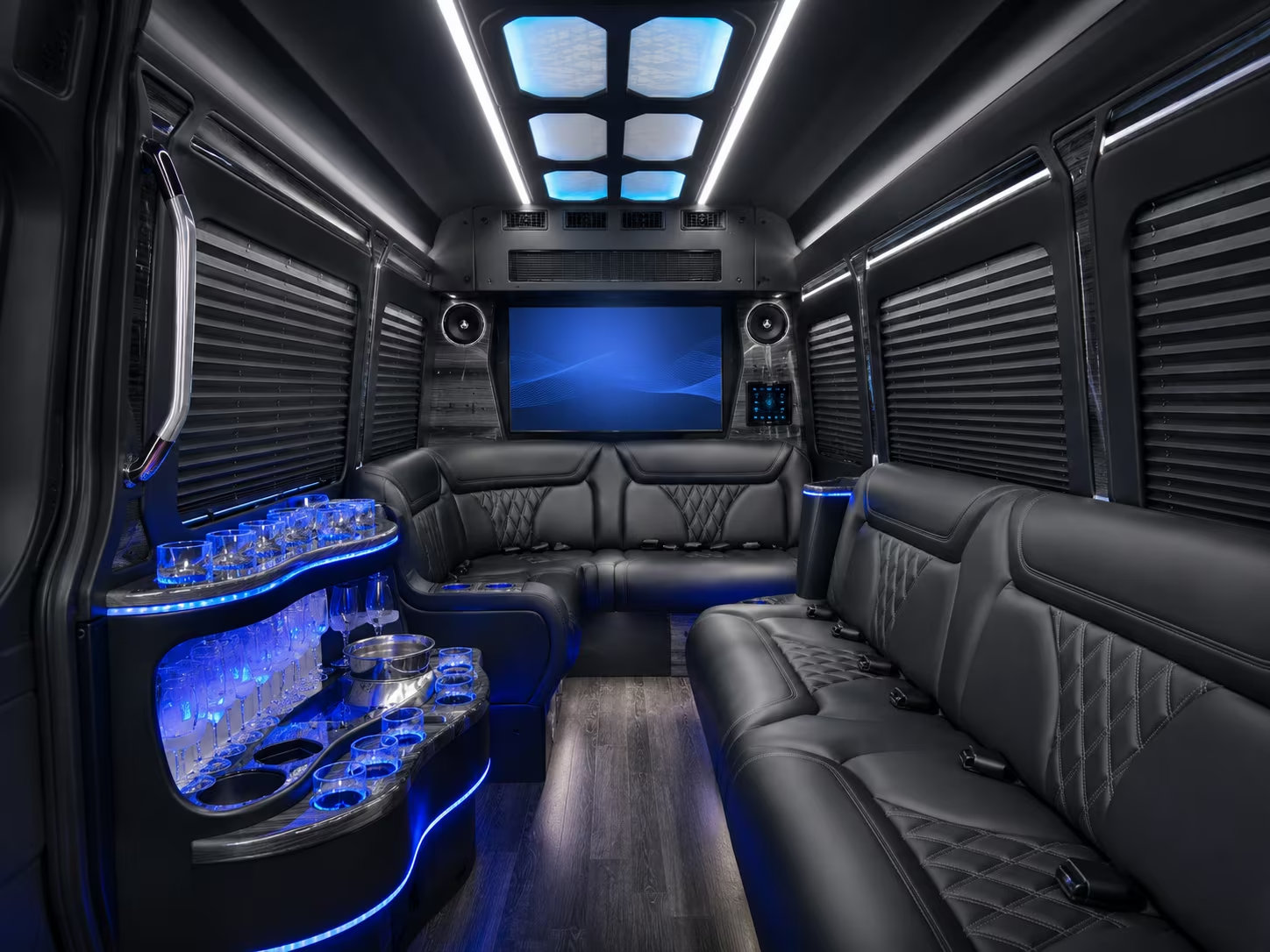
| Sprinter van or Sprinter limo | Up to ~14 | Rear cargo area — a few bags each | Small corporate or VIP transfers, bridal party arrivals |
| 15–35 passenger minibus | 15–35 | Overhead bins plus limited underfloor | Mid-size wedding parties, corporate teams, sports groups |
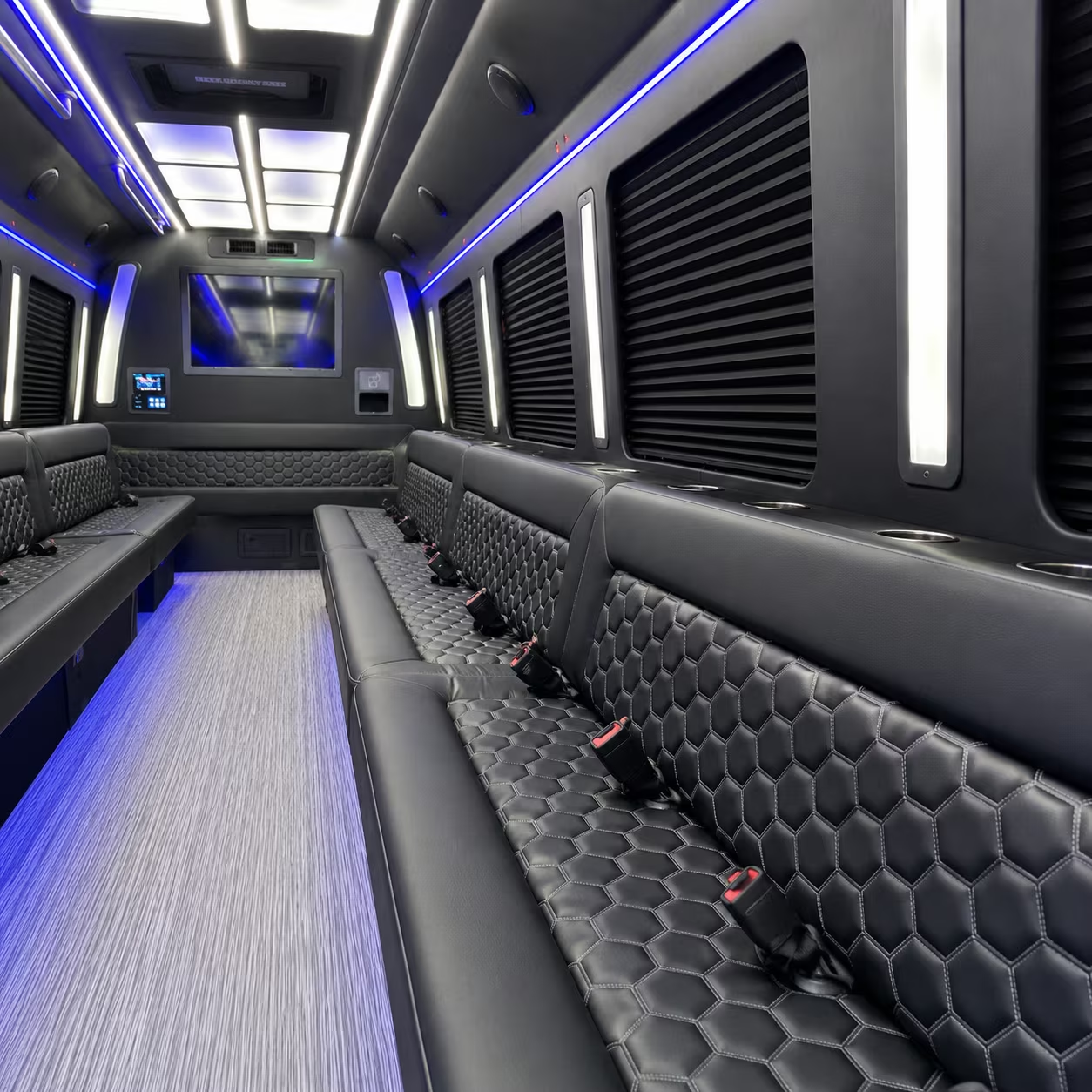
| Party bus (15–50 passengers) | 15–50 | Onboard storage — carry-on scale | Bachelorette and birthday group arrivals and departures |
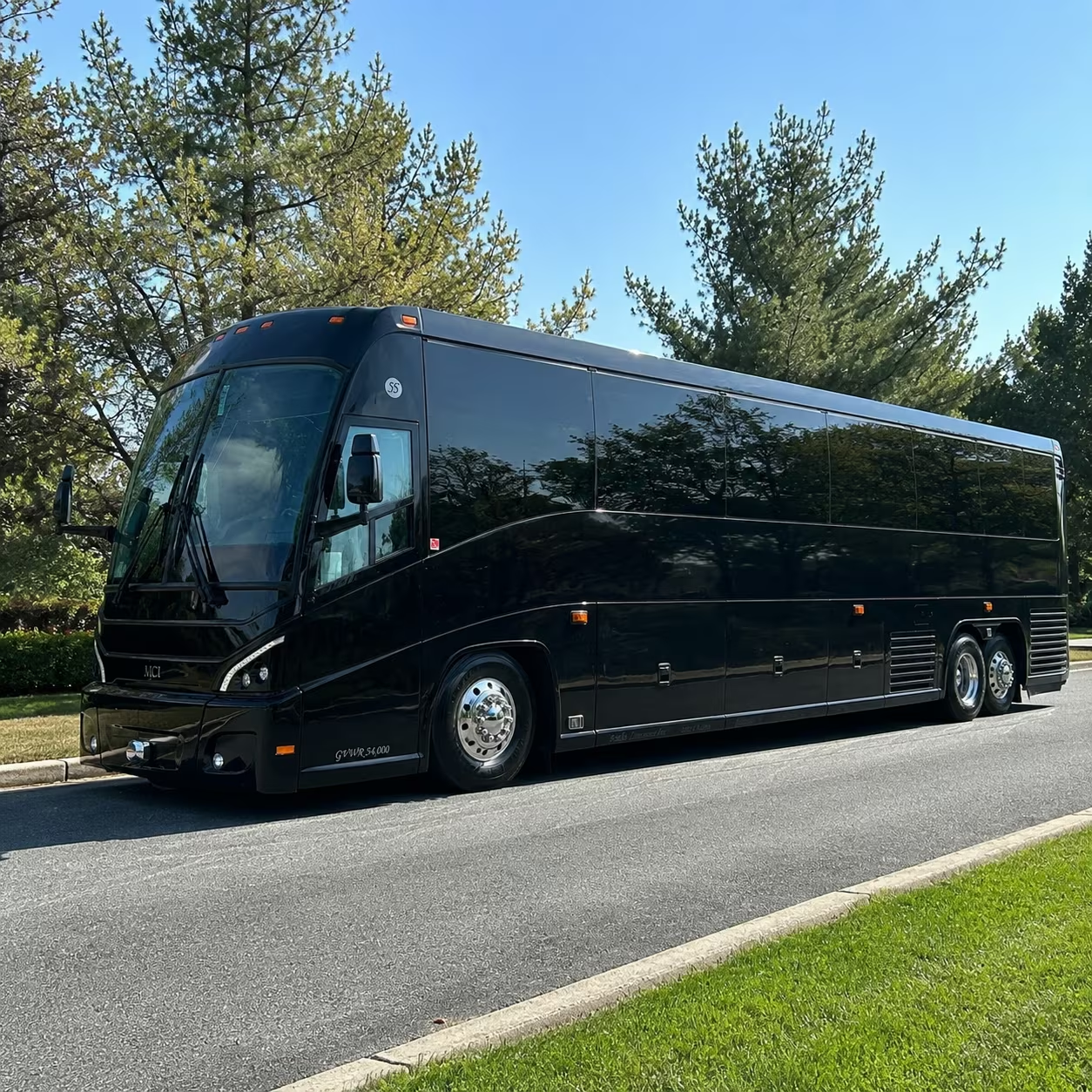
| 40–56 passenger charter bus | Up to 56 | Deep undercarriage bays — full checked-bag loads, equipment cases | Convention groups, large corporate teams, destination wedding guests |
For a NAB or SEMA delegation checking broadcast equipment cases or automotive samples, a full-size charter bus with deep undercarriage bays is the only vehicle that handles the cargo without compromising passenger space. A 40-person group with 80 suitcases will fill a charter bus's bays and still have room to spare — the same group in three minibuses is a luggage puzzle nobody wants to solve at a busy arrivals curb. ADA-accessible vehicles are available through the network; just note it in the quote request.
Browse the full vehicle lineup to compare sizes and amenities side by side.
Las Vegas Airport Charter Bus and Party Bus Rental Prices
Airport transfers at LAS are typically quoted as either a flat point-to-point rate or an hourly block covering pickup, the drive, and a small buffer window at the curb. To give you an idea of where rates land: a Las Vegas minibus rental for an airport run generally runs $200 to $250 per hour on a weekday or $200 to $275 on a weekend. A full 40-to-56 passenger charter bus runs $200 to $350 per hour on either day type.
A Sprinter van for a smaller executive transfer falls in the $200 to $275 weekday range; a Sprinter limo runs $200 to $325. Party bus rates for celebration group pickups start from $200 to $350 per hour depending on the vehicle size and date. None of those are guarantees — the actual quote shifts with your specific date, vehicle, hours, and how many stops the run involves.
The Las Vegas party bus prices page has current range details, or call 702-273-3530 any time — exact pricing for your trip takes about a minute.
The per-head math is the compelling part. Forty people splitting a charter bus are each paying a fraction of what 40 individuals would spend individually on rideshares — without the surge multiplier that convention weeks reliably produce. One flat rate, confirmed before anyone lands, with no surprise 3x multiplier at 9 p.m. when 90,000 NAB attendees are all leaving the Convention Center at once.
CES, SEMA, and NAB: When Harry Reid Airport Runs at Full Tilt
Las Vegas hosts some of the largest trade shows anywhere, and all of them funnel hundreds of thousands of travelers through LAS within compressed arrival and departure windows. These are the dates where booking a Las Vegas airport charter bus rental in advance is not optional — it is the difference between a confirmed vehicle at the right size and scrambling for substitutes the week before.
CES (Consumer Electronics Show) runs in early January — in 2026, January 6 through 9 — drawing 180,000-plus attendees to the Las Vegas Convention Center, Venetian Expo, and meeting spaces across the Strip. The Sunday before CES and the Thursday evening of the show are the peak airport windows; rideshare wait times during those hours routinely run 30 to 45 minutes, with surge pricing at two to three times the standard fare. Corporate groups flying in from multiple hub cities routinely request a charter bus at LAS to consolidate from two terminals into one vehicle and arrive at the Convention Center as a single delegation instead of straggling in across an hour.
NAB Show (National Association of Broadcasters) fills the Convention Center every April — 90,000-plus media and broadcast professionals, many checking oversize equipment cases and camera gear that needs a charter bus's undercarriage bays to load cleanly. SEMA in November (November 3–6 in 2026, with 160,000-plus attendees) is the fall version of the same problem — same gridlock, same surge windows, and the same argument for a confirmed bus at a locked rate instead of chasing rideshare confirmations during the Sunday-evening convention exodus from the Strip.
For any of these windows, vehicle supply in Las Vegas tightens significantly in the weeks before. Four to six weeks ahead of CES or SEMA is the realistic minimum for securing a good vehicle; eight to twelve weeks out gives the widest selection and more competitive rates. Waiting until the week before a major convention almost always means higher pricing, smaller inventory, or both.
Call 702-273-3530 to confirm availability for your specific dates as soon as your travel is booked. Going to the Convention Center, Allegiant Stadium, or another major venue from the airport on the same trip? The Convention Center group transportation guide and the Allegiant Stadium guide cover the on-venue logistics from there.
Practical Tips for Your Harry Reid Airport Group Run
Confirm every passenger's terminal before departure day. Check each traveler's airline against the table above well before the trip. If the group mixes American (T1) and United (T3), plan a two-stop run and add 15 to 20 minutes for the inter-terminal leg.
Two stops in sequence is completely standard at LAS — the only thing that goes wrong is not planning for it.
Use the gather-first rule without exception on inbound pickups. Domestic bags typically hit the carousel 15 to 25 minutes after landing; international bags take 30 to 45 minutes, sometimes longer from a full widebody. The group coordinator calls for the bus to pull forward only after every bag is in hand and every person is at the door.
At Terminal 1 that is Level 0, west side, Doors 7–13. At Terminal 3 it is Level 0, Door 51 for domestic arrivals or Doors 57–58 for international arrivals.
Build real buffer time into departures. Two and a half hours before an international flight at Terminal 3; two hours before a domestic flight at either terminal. Terminal 3's Level 2 departure curb adds a vertical transition with luggage that Terminal 1 does not have — that extra step compounds with group size.
For a 30-person departure, the check-in and bag-drop queue alone adds 15 to 20 minutes beyond what a solo traveler would budget.
Do not treat the inter-terminal shuttle as the primary plan for a split group. The free shuttle on the airport's official inter-terminal shuttle page runs every 20 to 30 minutes, takes about 10 minutes, and is shared with all airport passengers. It is a workable backup for one or two people who need to switch terminals.
It is not a plan for consolidating a 25-person group split across two campuses — that requires a private two-stop run with the bus staged at each terminal in sequence.
Departure terminal confusion is the most preventable problem at LAS. United and Alaska depart from Terminal 3. American, Delta, Southwest, and Allegiant depart from Terminal 1.
Knowing this before the bus is dispatched costs nothing. Discovering it at the curb in the departures lane costs 15 to 20 minutes and a re-route that the tight curb timing makes stressful.
Frequently Asked Questions
Where does a charter bus or party bus pick up at Terminal 1 at Harry Reid Airport?
At Terminal 1, group and commercial shuttle vehicles pick up from Level 0 on the west side of baggage claim, outside Doors 7 through 13. Baggage claim is on Level 1, so after collecting bags, passengers take the elevator or escalator down one level to Level 0, exit toward the covered parking garage, and cross the pedestrian walkway to the commercial vehicle zone. The rideshare zone (Uber/Lyft) is on Level 2 of the parking garage — two levels up from Level 0 — so the group coordinator needs to communicate the correct level clearly before the group splits at the carousels.
Where does a charter bus or party bus pick up at Terminal 3?
At Terminal 3, commercial vehicle and shuttle pickups are on Level 0: domestic arrivals exit near Door 51 on the west end of the building, and international arrivals exit near Doors 57–58 on the east end. If your group is all-domestic, Door 51 is the consolidation point. If the group includes international arrivals, designate one door in advance and have passengers walk the Level 0 corridor to meet there rather than splitting the pickup between two ends of the terminal.
Where is the departures drop-off curb at Terminal 1 vs. Terminal 3?
At Terminal 1, the departures curb is on Level 1, the same floor as ticketing and check-in — the bus pulls up and the group moves directly to the bag-drop lines with no level change. At Terminal 3, the departures curb is on Level 2, one level above the arrivals floor. Groups departing from Terminal 3 carry bags from the Level 2 curb down to the check-in counters, which is why Terminal 3 outbound runs need more time built in than Terminal 1.
Which airlines use Terminal 1 and which use Terminal 3 at Harry Reid Airport?
Terminal 1 serves Allegiant Air, American Airlines, Delta Air Lines, Southwest Airlines, and Advanced Air. Terminal 3 serves Alaska Airlines, United Airlines, and all international carriers — Air Canada, British Airways, KLM, Aer Lingus, Virgin Atlantic, Aeromexico, Avianca, JetBlue, Korean Air, and others. Always confirm your specific flight at booking, since airline terminal assignments can change with schedule updates.
How long is the drive from the Las Vegas Strip to Harry Reid Airport?
Off-peak, the Strip-to-airport run takes 10 to 20 minutes depending on where on the Strip you start. The South Strip (Mandalay Bay area) is about 2 miles and 8 to 12 minutes. The North Strip (Wynn, Encore) is closer to 5 miles and 15 to 25 minutes.
During CES week in January, SEMA in November, or the post-show window after a major Allegiant Stadium or Sphere event, add 15 to 30 minutes to those estimates. For an early-morning weekday departure from the center Strip, 5 to 6 a.m. typically means 12 to 15 minutes; the same trip at 4 p.m. on a CES Tuesday can take 40.
How much does it cost to rent a bus for a Las Vegas airport transfer?
Las Vegas airport bus rental pricing depends on vehicle size, the number of hours, your date, and how many stops are involved. To give you a planning range: a minibus runs $200 to $250 per hour on a weekday; a full charter bus runs $200 to $350 per hour. For a group of 40, that per-head rate frequently beats individual rideshares — especially during convention week when surge pricing is in effect.
Call 702-273-3530 or use the online form for pricing specific to your date and group. A quote takes about a minute.
How early should I book a bus for a Harry Reid Airport transfer?
For standard off-peak dates, two to four weeks of lead time is workable. For CES (January), NAB (April), and SEMA (November), four to eight weeks ahead is the realistic minimum — vehicle supply in Las Vegas contracts sharply during major convention windows, and the right-size bus at a reasonable rate goes to early bookers. For the biggest conventions, eight to twelve weeks out gives the best selection and pricing.
Can the bus make two terminal stops for a group split between Terminal 1 and Terminal 3?
Yes — a two-stop airport run covering both terminals is a standard request for mixed-carrier groups at LAS. For arrivals, the bus typically collects the first-landing group at their terminal's Level 0 curb and holds at the second terminal for the later-arriving batch. For departures, Terminal 3 first (Level 2 curb, more time needed) then Terminal 1 is the efficient sequence.
Add 15 to 20 minutes for the inter-terminal leg and account for it in the departure-timing plan. Confirm the two-stop sequence at booking so the pickup is pre-planned, not improvised at the curb.
Does the free inter-terminal shuttle work for a large group?
The free shuttle — detailed on the airport's inter-terminal shuttle page — runs approximately every 20 to 30 minutes and takes about 10 minutes between terminals. For one or two passengers who need to switch terminals, it is a fine option. For a 20-person group trying to consolidate, it is not — it is a shared public vehicle and it does not hold a private group together.
The right answer for a split-terminal group is a private two-stop run, not relying on the public shuttle to reunite a large group on different ride cycles.
Does the Vegas Loop serve Harry Reid Airport for group pickups?
The Vegas Loop currently provides drop-off service on the departures side of the airport. Pickup from the arrivals level is expected to expand once the underground airport connector tunnels open. When that service activates, arrivals pickups are planned for Level 0 areas — the same zones used by commercial shuttles.
For large groups with checked bags, the Loop's small passenger pods (typically 1 to 6 people) are not a practical group transportation solution regardless of connectivity. Check the current Boring Company service map for the latest on airport pickup availability before your trip.
What is the address and approach road for each terminal?
Both terminals share the address 5757 Wayne Newton Blvd, Las Vegas, NV 89119. Terminal 1 is accessed directly from Wayne Newton Boulevard, reached from the Strip via Tropicana Avenue east to Wayne Newton Blvd. Terminal 3 is most directly reached via Paradise Road southbound from the center and south Strip — follow the overhead signs for T3. Groups arriving from Henderson or the southeast valley use the Harry Reid Airport Connector off the I-215 Beltway.
Book Your Las Vegas Airport Bus Today
Whether your group is consolidating a split-terminal corporate arrival, staging a bachelorette group pickup at Terminal 3, or running a 40-person convention team from CES to their Strip hotel with two bags each — Partybus-las-vegas.com makes it easy to compare charter buses, party buses, minibuses, and Sprinter vans serving Harry Reid International Airport through a large network of bus companies in the Las Vegas area. One form, one call, pricing in about a minute. Call 702-273-3530 any time.
For group transportation across Las Vegas once the bags are dropped — concerts at T-Mobile Arena, events at the Sphere, or a multi-day convention itinerary — the Las Vegas group transportation services page covers what is available city-wide for groups that start at the airport and end up everywhere.